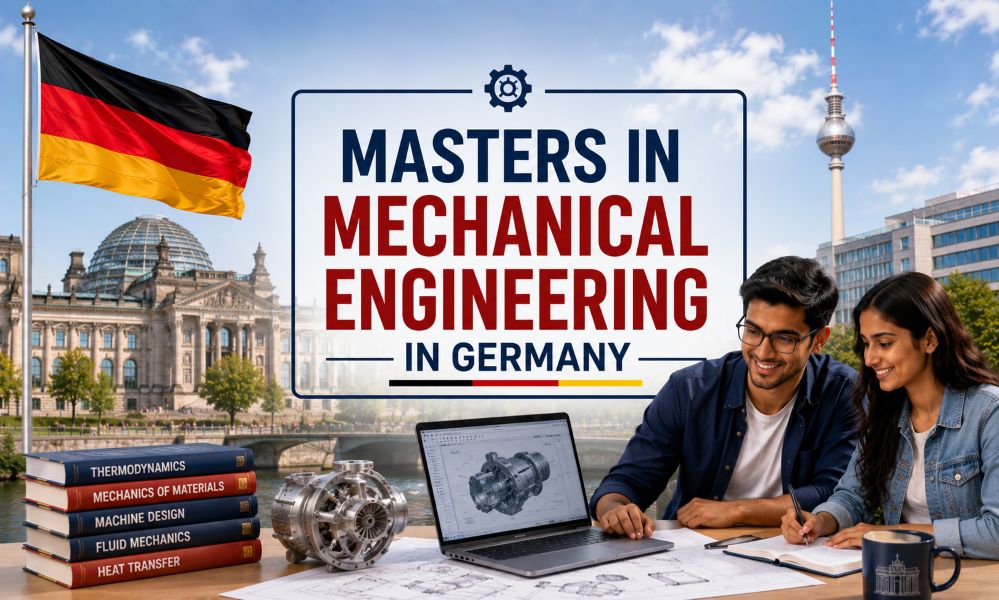

MSc in Mechanical Engineering in Germany 2026
Table of Contents
- Top Universities for MSc in Mechanical Engineering in Germany
- Core Subjects and Specializations
- Eligibility & Admission Requirements for MSc in Mechanical Engineering in Germany
- Cost of Studying MSc in Mechanical Engineering in Germany
- Intakes & Admission Process for MSC in Mechanical Courses
- How to Apply for MSc in Mechanical Engineering in Germany
- Top Cities to Study Msc in Mechanical Engineering in Germany
- Job Opportunities After MSc in Mechanical Engineering in Germany
- Conclusion
Top institutions such as Technical University of Munich, RWTH Aachen University, Karlsruhe Institute of Technology, and Technical University of Berlin are globally recognized for engineering excellence. Graduates can expect average salaries ranging from €50,000 to €70,000 annually (approximately ₹45L–₹63L), depending on experience and specialization, making it a strong return on investment for students pursuing this field.
Key Highlights:
Germany is known for its strong engineering education, and its master’s programs reflect that with a focus on real-world applications and industry connections. This practical approach gives students an advantage in the job market after graduation.
Another key benefit is affordability, as public universities offer low or no tuition fees, making Germany cheaper than USA or UK. Most programs last two years and combine technical learning with research, while many are taught in English, making them accessible for international students.
Here’s a quick overview of what to expect:
Parameters | Details |
Program Duration | 2 years (full-time) |
Tuition Fees (Semester) | €300–€500 (₹27,000–₹45,000) |
Top Universities | RWTH Aachen, TUM, Stuttgart |
Average Salary | €50,000–€70,000/year(₹45.7L-₹63.1L) |
Work Rights | 120 days/year |
Top Universities for MSc in Mechanical Engineering in Germany
Germany has some of the highest-ranked engineering universities globally, and many of them specialize deeply in mechanical engineering. These universities are known for strong research output, advanced labs, and industry collaboration.
What actually matters here is not just rankings but the kind of exposure you get. Universities with strong ties to automotive, robotics, or manufacturing industries give you better internship and job opportunities. That’s where Germany really stands out.
Most top universities focus on innovation-driven learning, meaning you’ll work on real projects, simulations, and industrial case studies. This kind of training directly impacts employability after graduation.
Here are some of the top universities based on engineering rankings:
QS World University Rankings 2026:
University Name | QS Ranking |
Technical University of Munich | =22 |
KIT, Karlsruhe Institute of Technology | =98 |
RWTH Aachen University | =105 |
Technische Universität Berlin (TU Berlin) | =145 |
University of Cologne | =272 |
Source : QS world universities
Core Subjects and Specializations
Mechanical engineering programs in Germany are not just theory-heavy they’re structured to match current industry demands. You’ll find a strong mix of core engineering principles along with modern technologies like AI, robotics, and automation.
This becomes important when you start choosing specializations. Your choice directly affects your career path automotive roles, robotics engineering, or energy systems all require different skill sets.
Another key advantage is access to advanced tools like CAD/CAM, simulation software, and industrial equipment. These are not optional they’re part of the learning process.
Here’s a breakdown of core subjects and focus areas:
Subject Area | Focus Topics | Career Relevance |
Thermodynamics | Heat transfer, energy systems | Energy & manufacturing |
Design & Manufacturing | CAD/CAM, production | Product & design roles |
Automotive Engineering | Vehicle systems, EV tech | Automotive industry |
Robotics & Automation | AI, mechatronics | Industry 4.0 roles |
Materials Science | Composites, metallurgy | R&D and production |
Eligibility & Admission Requirements for MSc in Mechanical Engineering in Germany
Getting into an MSc in Mechanical Engineering in Germany is fairly straightforward if your fundamentals are strong. Universities mainly focus on your academic background, relevant coursework, and language proficiency.
The key thing students often miss is alignment. Your bachelor’s degree should closely match mechanical engineering subjects like thermodynamics, mechanics, and materials. If your coursework doesn’t align, admission becomes difficult even with good grades.
Language requirements depend on the program. English-taught programs require IELTS or TOEFL, while German-taught courses need TestDaF or DSH. Indian students must also complete APS certification, which is now mandatory.
Here’s a simplified view:
Requirement | Top Universities | Mid-Tier Universities |
Academic Score | 60–65%+ | 55–60% |
IELTS | 6.5+ | 6.0–6.5 |
Work Experience | Optional | Preferred |
Cost of Studying MSc in Mechanical Engineering in Germany
Cost is one of the biggest reasons students choose Germany. Public universities charge little to no tuition fees, which makes it far more accessible compared to other study destinations.
However, living expenses are something you need to plan carefully. Cities like Munich and Stuttgart are expensive, while smaller cities are more affordable. What actually matters is budgeting smartly rather than just looking at tuition fees.
On average, students spend around €900–€1,000 (₹1.0L–₹1.1L) per month per month on living expenses, including accommodation, food, and transport. This adds up, so financial planning is crucial.
Here’s a cost breakdown:
Category | Cost (EUR) | Cost (INR) |
Public University Fees | €300–€500 | (₹27,000-₹45,000) |
Private University Fees | €11,000–€17,000 | ₹11.4L–₹17.6L |
Living Costs (Annual) | €11,822 | ₹12L approx. |
H2: Scholarships for MSc in Mechanical Engineering in Germany
Germany offers several scholarships that can significantly reduce your financial burden, especially since tuition is already low at public universities. Most scholarships are merit-based, but some also consider work experience, leadership skills, and overall profile strength. Applying early with a strong SOP can improve your chances.
Scholarship | Eligibility | Benefits |
DAAD | Strong academics + relevant experience | €934–€992/month (₹84K–₹90K) + insurance + travel allowance |
Erasmus+ | Admission to partner universities/programs | Full tuition + stipend (approx ₹90K–₹1.5L/month) |
Deutschlandstipendium | Merit-based (academic excellence) | €300/month (₹27K approx.) |
Heinrich Böll Foundation | Strong academics + social involvement | €850–€1,200/month (₹75K–₹1.05L) |
Konrad-Adenauer-Stiftung | Academic excellence + leadership potential | €850–€1,200/month (₹75K–₹1.05L) |
These scholarships can even cover living expenses, which is the biggest expense for students in Germany, making them highly valuable but competitive.
Intakes & Admission Process for MSC in Mechanical Courses
Germany has two main intakes Winter and Summer. The Winter intake (October) is the primary one, offering the maximum number of courses and seats.
What actually matters is timing. Applications usually close months before the intake, so planning ahead is critical. Many universities also follow rolling admissions, which means earlier applications get priority.
Students often delay document preparation, especially APS certification, which can slow down the entire process. Starting early avoids unnecessary stress later.
How to Apply for MSc in Mechanical Engineering in Germany
The application process is structured but requires attention to detail. Missing documents or incorrect submissions can delay or even reject your application.
You’ll typically apply through university portals or centralized systems. Each university may have slightly different requirements, so checking details is important.
Steps include:
Research universities
Check eligibility
Take required tests
List the documents
Submit application
Attend interview (if required)
Student Visa Requirements
A German student visa is mandatory for international students. The process is straightforward but involves financial proof and documentation.
The most important requirement is the blocked account, where you must deposit funds to show you can cover living expenses. This is a key step and often takes time to arrange.
Visa approvals usually take 4–12 weeks, so applying early is important to avoid delays.
Blocked Account : €11,208 (₹11.6L)
Processing Time : 4–12 weeks
Top Cities to Study Msc in Mechanical Engineering in Germany
Choosing the right city affects your overall experience. Some cities offer better job opportunities, while others are more affordable for students.
Cities like Munich and Stuttgart are known for automotive industries, while Berlin is more focused on tech and startups. This directly impacts internships and networking opportunities.
Here’s a quick comparison:
City | Strength | Career Advantage |
Munich | Automotive hub | BMW, Siemens |
Stuttgart | Manufacturing | Mercedes, Bosch |
Berlin | Tech ecosystem | Startups, research |
Aachen | Engineering cluster | Industrial exposure |
Job Opportunities After MSc in Mechanical Engineering in Germany
Germany has one of the strongest job markets for mechanical engineers. The country’s focus on manufacturing, automotive, and Industry 4.0 creates consistent demand for skilled graduates.
What actually matters is specialization. Students in robotics, automation, and automotive engineering tend to get higher-paying roles compared to general mechanical fields.
Salaries are competitive, and the 18-month job search visa gives you enough time to secure a role after graduation.
Role | Salary (EUR) | Salary (INR) |
Project Engineer | €45,000–€65,000 | ₹41L–₹60L |
Mechanical engineer |
|
|
Automotive Engineer | €46,000–€78,000 | ₹42L–₹72L |
Robotics Engineer | €53,000–€72,000 | ₹49L–₹66L |
Design Engineer | €48,000–€65,000 | ₹44L–₹60L |
Source: Glassdoor
Conclusion
An MSc in Mechanical Engineering in Germany is a strong option if you’re looking for quality education, industry exposure, and long-term career growth. The low tuition fees and high employability make it a practical decision, not just an academic one.
What really makes the difference is how you plan your journey choosing the right specialization, applying early, and building relevant skills during your course. Get that right, and Germany can open doors to a solid global engineering career.