Masters in Computer Science in Germany
Table of Contents
- Why Study Masters in Computer Science in Germany?
- Top Universities for Masters in Computer Science in Germany
- Course Structure of Masters in Computer Science in Germany
- Eligibility Requirements for Masters in Computer Science in Germany
- Cost of Studying for Masters in Computer Science in Germany
- Cost of Living for Masters in Computer Science Students in Germany
- Scholarships for Masters in Computer Science in Germany
- Intakes and Admission Process for Masters in Computer Science in Germany
- Admission Process for Masters in Computer Science in Germany
- Student Visa Requirements for Masters in Computer Science in Germany
- Job Opportunities After Masters in Computer Science in Germany
- Final Thoughts from Author
Germany offers world-class, tuition-free Master's in Computer Science (MS in CS) programs at public universities.
Most programs take two years and cover 120 ECTS credits. Top universities such as TUM, TU Berlin, LMU Munich, KIT, and RWTH Aachen offer courses in AI, data science, cybersecurity, and software engineering.
Many public universities charge little or no tuition, though some charge fees for non-EU students.
Applicants usually need a relevant bachelor’s degree, English language test scores, academic documents, and proof of funds for a German student visa.
The table below provides a quick overview of the program before you explore the details:
Particular | Details |
Degree | Master of Science (MSc) |
Top Universities | Technical University of Munich #26 |
Duration | 2 Years (120 ECTS) |
Tuition Fees | €0-€6,000/semester (≈ INR 0-INR 7 L) depending on university |
Semester Contribution | €150-€350 (≈ INR 16,000-INR 38,000) |
Living Cost | €900-€1,500/month (≈ INR 1 L-INR 2 L) |
Blocked Account | €11,904/year (≈ INR 13 L) |
English Requirement | IELTS 6.5+ / TOEFL iBT 88-95+ |
Scholarships | DAAD, Deutschlandstipendium, Erasmus+, University Scholarships |
Work During Study | 140 full days or 280 half days/year |
Post-study Stay | Up to 18 months |
Average Salary | €50,000-€80,000/year (≈ INR 55 L-INR 87 L) |
Why Study Masters in Computer Science in Germany?
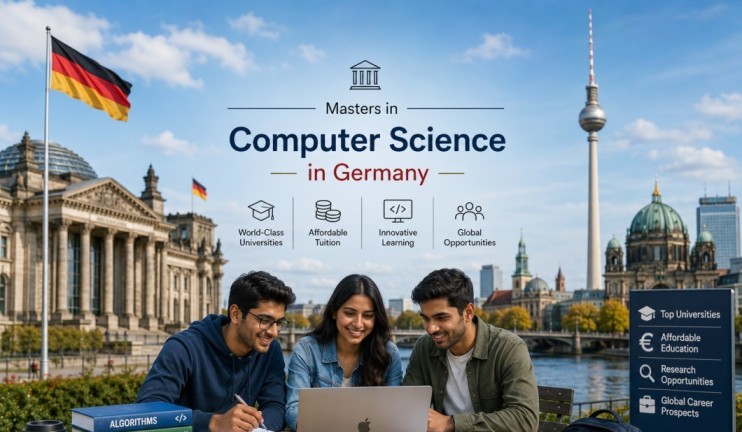
Germany is a popular choice for a Master’s in Computer Science because it offers affordable education, strong research facilities, English-taught programs, and excellent career opportunities in fields such as AI, software development, cybersecurity, and data science.
Many public universities charge little or no tuition, and graduates can stay for up to 18 months to find work.
Why do students choose Germany?
Highly ranked universities recognised worldwide.
Large number of English-taught master's programs.
Strong research opportunities in AI, Robotics, Machine Learning, and Cybersecurity.
Access to Europe's largest economy and technology sector.
Opportunity to stay in Germany for 18 months after graduation to search for employment.
International students can work 140 full days or 280 half days per year during studies.
Things should consider:
Living expenses are your biggest cost.
Learning German is not mandatory for many programs but significantly improves internship and job opportunities.
Admission is competitive because universities carefully evaluate your previous academic background and subject credits.
Top Universities for Masters in Computer Science in Germany
Germany is a popular destination for a Master’s in Computer Science because many public universities offer affordable education, strong research facilities, industry partnerships, and globally recognised degrees.
However, tuition policies vary. Many public universities charge only a semester contribution, while TUM and public universities in Baden-Württemberg, including KIT, may charge tuition fees for non-EU students.
Always check the official university website before applying.
The table below compares the leading Universities in Germany for Masters in Computer Science:
Top Universities for Masters in Computer Science in Germany | QS World University Rankings by Subject 2026: Computer Science and Information Systems
| Tuition Fee (Approx.) |
Technical University of Munich | 26 | €6,000/semester (≈ INR 7 L) |
Technische Universität Berlin | =76 | Semester contribution only |
Ludwig-Maximilians-Universität München | =91 | Semester contribution only |
Karlsruhe Institute of Technology | 110 | €1,500/semester (≈ INR 2 L) |
RWTH Aachen University | =114 | Semester contribution only |
Humboldt University of Berlin | =149 | Semester contribution only |
Technical University of Darmstadt | =156 | Semester contribution only |
Course Structure of Masters in Computer Science in Germany
A Master’s in Computer Science in Germany usually lasts two years and carries 120 ECTS credits.
The program combines advanced coursework, electives, practical projects, and a final research thesis, preparing students for industry roles, research, or PhD studies.
The table below explains the typical curriculum structure.
Component | Typical Credits | Purpose |
Core Courses | 45-60 ECTS | Advanced computer science concepts |
Elective Modules | 20-30 ECTS | Specialisation subjects |
Research Project / Lab | 10-20 ECTS | Practical learning |
Master's Thesis | 30 ECTS | Independent research |
Core Subjects in Masters in Computer Science in Germany
A Master’s in Computer Science in Germany is generally research-focused and allows students to develop expertise in a specialised area.
Although the course structure varies across institutions, most programs combine advanced theoretical foundations with applied and research-oriented subjects.
Students usually complete core computer science modules before choosing electives or a specialisation based on their academic interests and career goals.
Common core subjects include:
Advanced Algorithms
Software Engineering
Distributed Systems
Database Systems
Artificial Intelligence
Computer Networks
Operating Systems
Machine Learning
Computer Security
Advanced Mathematics
Popular Specializations in Masters in Computer Science in Germany
Germany’s strong technology, research, and industrial sectors make its Master’s in Computer Science programs highly sought after.
Popular specialisations include Artificial Intelligence, Data Science, Cybersecurity, Software Engineering, and Human Computer Interaction.
Students usually choose a specialisation based on their academic interests, technical strengths, and future career goals.
These programs can prepare graduates for opportunities in technology and engineering companies such as SAP, Siemens, and Bosch.
The table below highlights the most common specialisations.
Specialisation | Career Opportunities |
Artificial Intelligence | AI Engineer, ML Engineer |
Data Science | Data Scientist |
Cybersecurity | Security Analyst |
Software Engineering | Software Developer |
Cloud Computing | Cloud Engineer |
Human-Computer Interaction | UX Engineer |
Embedded Systems | Embedded Systems Engineer |
Robotics | Robotics Engineer |
Eligibility Requirements for Masters in Computer Science in Germany
To study Masters, you must have a relevant bachelor's degree, meet the university's academic requirements, and submit proof of English or German language proficiency.
Since admission is competitive at many universities, institutions also evaluate your previous coursework, grades, and subject-specific credits.
Some universities may additionally ask for detailed module descriptions to assess whether your previous studies match the required Computer Science background.
The table below summaries the common admission requirements:
Requirement | Typical Requirement | Remarks |
Bachelor's Degree | Computer Science or related discipline | Minimum 3 years |
Academic Performance | Good GPA/Percentage | University-specific |
English Language | IELTS/TOEFL/PTE | Required for English-taught programs |
German Language | Required only for German-taught courses | TestDaF/DSH/Goethe |
APS Certificate | Required for Indian applicants | Mandatory for visa |
SOP | Required | Statement of Purpose |
CV/Resume | Required | Latest academic/professional profile |
LORs | Usually 2 | Academic or professional |
Academic Requirements for Masters in Computer Science in Germany
To pursue a Master’s in Computer Science in Germany, international students generally need a German National Student Visa, also known as a Type D visa.
Applicants must first obtain an admission letter from a recognised German university.
The table below explains the common academic requirements:
Requirement | Typical Expectation |
Relevant Bachelor's Degree | Computer Science, IT, Software Engineering, Data Science or related field |
Computer Science Credits | Around 90-120 ECTS equivalent depending on university |
Mathematics Credits | Calculus, Linear Algebra, Statistics, Discrete Mathematics |
Programming Background | Strong foundation expected |
Academic Grades | Competitive GPA improves admission chances |
Note: Some universities may grant conditional admission if a few prerequisite subjects are missing.
English Language Requirements for Masters in Computer Science in Germany
For an English-taught Master’s in Computer Science in Germany, applicants are generally required to submit an IELTS Academic or TOEFL iBT score.
Many computer science master’s programs in Germany are taught fully in English.
Therefore, international applicants must usually demonstrate English language proficiency through an internationally recognised test.
The table below compares commonly accepted scores:
Test | Typical Requirement |
IELTS Academic | 6.5-7.0 |
TOEFL iBT | 88-95+ |
PTE Academic | Accepted by selected universities |
Cambridge English | Accepted by some universities |
Note: Some universities may waive English language requirements if your previous degree was completed entirely in English, but this policy varies by institution.
Cost of Studying for Masters in Computer Science in Germany
Most public universities in Germany do not charge regular tuition fees for a Master’s in Computer Science.
However, students are generally required to pay a semester contribution, which may cover administrative charges, student services, and local public transport.
As a result, the overall cost of studying a Master’s in Germany is often lower than in many other popular study destinations.
Tuition policies vary by university and federal state. While many public universities charge only a semester contribution, some institutions may impose additional tuition fees on international or non-EU students.
The table below compares tuition costs:
University Type | Tuition Fee |
Most Public Universities | No tuition + semester contribution |
TUM | €6,000/semester (≈ INR 7 L) |
KIT (Non-EU) | €1,500/semester (≈ INR 2 L) |
Private Universities | €10,000-€30,000/year (≈ INR 11 L-INR 33 L) |
Note: Always verify tuition fees on the official university website before applying because fee policies can change.
Cost of Living for Masters in Computer Science Students in Germany
Living as a master's in computer science student in Germany costs between €900 and €1,200 (₹80,000 to ₹1,06,000) per month.
Most public universities do not charge regular tuition fees, although students may need to pay semester contributions.
Living costs depend largely on the city you choose. Munich, Frankfurt, Hamburg, and Berlin are generally more expensive than smaller university towns.
The table below provides an approximate monthly budget:
Expense | Monthly Cost |
Accommodation | €400-€800 (≈ INR 44,000-INR 87,000) |
Food | €200-€350 (≈ INR 22,000-INR 38,000) |
Health Insurance | €120-€150 (≈ INR 13,000-INR 16,000) |
Transport | €50-€100 (≈ INR 5,000-INR 11,000) |
Miscellaneous | €100-€150 (≈ INR 11,000-INR 16,000) |
Scholarships for Masters in Computer Science in Germany
Scholarships can help reduce the cost of studying a Master's in Computer Science in Germany, especially your living expenses.
Many public universities charge low or no tuition fees, but students still need to budget for accommodation, food, health insurance, and other daily expenses.
The most popular scholarships are offered by the German government, universities, and private foundations for eligible international students.
The table below compares the major scholarship opportunities.
Scholarship | Benefits |
DAAD Scholarships | €992 (≈ INR 1 L)/month stipend, travel allowance, insurance |
Deutschlandstipendium | €300/month (≈ INR 33,000) |
Erasmus+ | Tuition and mobility funding |
Heinrich Böll Foundation | Monthly stipend |
University Scholarships | Vary by institution |
Intakes and Admission Process for Masters in Computer Science in Germany
German universities generally offer two admission intakes each year: Winter and Summer.
The Winter Intake is the main admission cycle, offering the largest number of Master's in Computer Science programs and available seats.
The Summer Intake is available at selected universities and usually has fewer English-taught courses.
The table below explains the major intakes:
Intake | Classes Begin | Typical Deadline |
Winter Intake | September/October | March-July |
Summer Intake | March/April | October-January |
Admission Process for Masters in Computer Science in Germany
Students can apply through the university's official application portal or Uni-Assist, depending on the university's admission process.
Preparing your documents early can help you meet application deadlines and avoid delays.
The admission process typically includes the following steps:
Shortlist universities.
Check eligibility requirements.
Prepare IELTS/TOEFL.
Apply for APS Certificate.
Prepare SOP, CV, transcripts, and LORs.
Submit applications through the university portal or Uni-Assist.
Receive admission letter.
Arrange finances and blocked account.
Apply for student visa.
Complete university enrolment after arrival.
Student Visa Requirements for Masters in Computer Science in Germany
To secure a German Student Visa (National Visa - Type D) for your Master’s in Computer Science, applicant must first obtain an admission letter from a recognized university.
Students are generally required to provide proof of sufficient financial resources, along with valid health insurance, academic documents, and accepted English or German language proficiency scores.
Applicants should ensure that all required documents are complete and valid before submitting their German student visa application.
The table below summaries the visa requirements:
Requirement | Details |
Admission Letter | Required |
Passport | Valid passport |
APS Certificate | Required for Indian students |
Blocked Account | €11,904/year (≈ INR 13 L) |
Health Insurance | Mandatory |
English Language Proof | IELTS/TOEFL if applicable |
Academic Documents | Degree, transcripts, SOP |
Job Opportunities After Masters in Computer Science in Germany
Germany offers excellent career opportunities for graduates with a Master's in Computer Science, especially in software engineering, artificial intelligence, cybersecurity, cloud computing, data science, and IT consulting.
After graduation, international students can apply for an 18-month post-study residence permit to look for skilled employment.
Once they secure a qualifying job, they can apply for the appropriate work or residence permit, depending on the latest immigration rules.
The table below shows common career options.
Job Role | Average Annual Salary |
Software Engineer | €50,000-€70,000 (≈ INR 55 L-INR 77 L) |
Data Scientist | €55,000-€80,000 (≈ INR 60 L-INR 87 L) |
AI Engineer | €55,000-€85,000 (≈ INR 60 L-INR 93 L) |
Cybersecurity Analyst | €50,000-€75,000 (≈ INR 55 L-INR 82 L) |
Cloud Engineer | €55,000-€80,000 (≈ INR 60 L-INR 87 L) |
Final Thoughts from Author
A Master’s in Computer Science in Germany can be a good option if you want quality education, strong research exposure, and better career opportunities at a reasonable cost.
However, it is important to compare universities carefully because tuition fees, course content, and admission requirements can differ.
Check the latest details, prepare your documents early, and choose a program that matches your career goals rather than focusing only on rankings.
Planning to pursue Masters in Computer Science in Germany? Book a free 1:1 counselling session with our study abroad experts for personalised guidance.
Also Read:
Masters in Berlin
Masters in Munich
Masters in Frankfurt
Masters in Hamburg