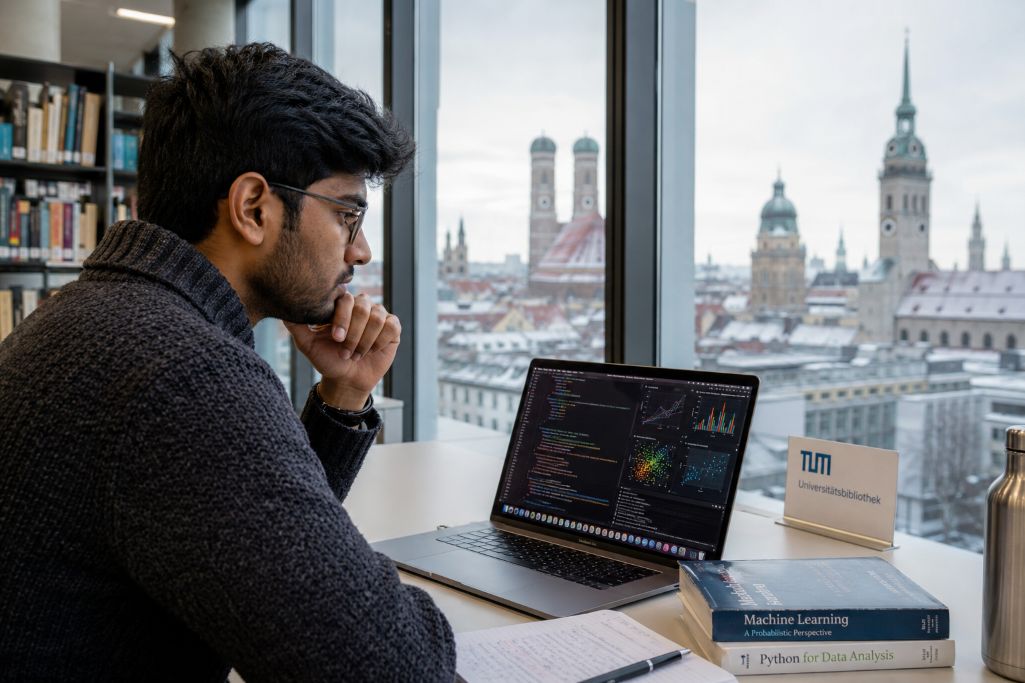

Engineering Masters in Germany
Table of Contents
- Best Universities for Engineering Masters in Germany
- Popular Engineering Master's Courses in Germany
- Engineering Specialisations in High Demand in Germany
- Best Cities to Study Engineering in Germany
- Cost of Studying Engineering Masters in Germany
- Public vs Private Universities for Engineering Masters
- Eligibility Requirements
- Intakes & Admission Timeline
- APS Certificate for Indian Students
- Scholarships for Engineering Masters in Germany
- How to Apply for Engineering Masters in Germany
- Is German Language Necessary?
- Career Opportunities After Engineering Masters in Germany
- Job Seeker Visa & Permanent Residency Pathway
- Author's Final Thought
Engineering Masters in Germany lasts 2 years (4 semesters) and is offered across specialisations such as Mechanical Engineering, Automotive Engineering, Robotics, Artificial Intelligence, Electrical Engineering, Civil Engineering, Computer Engineering and Renewable Energy. Most German public universities charge no tuition fees, requiring students to pay only a semester contribution of approx. €150–350 (₹15,000–35,000).
For Indian students, admission generally requires a relevant Bachelor's degree (BE/BTech or equivalent), a strong academic record (typically 70–75% or above for competitive universities), proof of English proficiency through IELTS or TOEFL for English-taught programs, and an APS Certificate, which is mandatory for German student visa applications. Students interested in German-taught courses must additionally demonstrate German language proficiency through examinations such as TestDaF or DSH.
Leading institutions such as Technical University of Munich (TUM), RWTH Aachen University, Karlsruhe Institute of Technology (KIT), TU Berlin, TU Dresden and the University of Stuttgart consistently rank among the world's best engineering universities and maintain close partnerships with multinational companies.
Key Highlights of Engineering Masters in Germany
Particular | Details |
Course Duration | 2 Years (4 Semesters) |
Tuition Fees | €0 Tuition at most Public Universities + Semester Fee of €150–350 (₹15,000–35,000) |
Living Expenses | Around €11,904/year (₹11.9 lakh approx.) |
Main Intakes | Winter (October) & Summer (April) |
English Requirement | IELTS 6.5+, TOEFL Equivalent |
German Requirement | Required only for German-taught programs |
APS Certificate | Mandatory for Indian Students |
Post-Study Work Permit | 18-Month Job Seeker Residence Permit |
Permanent Residency Pathway | EU Blue Card & German PR |
Popular Fields | Mechanical, Automotive, AI, Electrical, Civil, Robotics |
This blog covers all information on Engineering masters in Germany , top university, admission requirements , tuition fees, scholarships, APS certification, visas, salaries, recruiters and career prospects.
Best Universities for Engineering Masters in Germany
Germany is home to several world-renowned technical universities that consistently perform exceptionally in global engineering rankings and maintain close ties with industry.
The table below highlights some of the best universities for Engineering Master's programs.
University | QS World Ranking 2027* | Popular Engineering Programs |
Technical University of Munich (TUM) | 25 | Mechanical, Robotics, AI |
Ludwig-Maximilians-Universität München | 61 | Automotive, Mechanical, Industrial |
Universität Heidelberg | 86 | Electrical, Civil, Mechanical |
Freie Universitaet Berlin | 98 | Computer Engineering, Energy |
RWTH Aachen University | 104 | Aerospace, Automotive |
KIT, Karlsruhe Institute of Technology | 110 | Electronics, Materials Engineering |
Popular Engineering Master's Courses in Germany
Germany offers specialised postgraduate education across almost every engineering discipline, allowing students to align their studies with future industry demands.
The table below highlights popular Engineering Master's programs.
Course | Popular Universities |
TUM, RWTH Aachen | |
University of Stuttgart, RWTH | |
Electrical Engineering | KIT, TU Dresden |
Civil Engineering | KIT, TUM |
Computer Engineering | TU Berlin, TUM |
Robotics & Artificial Intelligence | TUM, TU Munich |
Engineering Specialisations in High Demand in Germany
Germany's engineering industry is evolving rapidly with increasing investments in automation, sustainability, electric mobility, semiconductor manufacturing, and artificial intelligence.
The table below highlights engineering specialisations currently experiencing strong industry demand.
Specialisation | Career Scope | Major Industries |
Automotive Engineering | Vehicle Design & Manufacturing | BMW, Mercedes-Benz, Audi |
Artificial Intelligence & Robotics | Automation & Machine Learning | Siemens, Bosch |
Renewable Energy Engineering | Sustainable Energy Systems | Siemens Energy, RWE |
Semiconductor Engineering | Chip Manufacturing | Infineon, GlobalFoundries |
Aerospace Engineering | Aircraft & Space Technology | Airbus, Lufthansa Technik |
Embedded Systems | Smart Devices & IoT | Bosch, Continental |
These emerging specialisations offer excellent long-term career opportunities as Germany continues investing heavily in Industry 4.0 technologies and sustainable engineering solutions.
Best Cities to Study Engineering in Germany
The city you choose influences your internship opportunities, industrial exposure, networking possibilities, cost of living, and long-term career prospects.
The table below compares Germany's leading engineering cities.
City | Top Universities | Major Industries |
TUM | BMW, Siemens, Airbus | |
Aachen | RWTH Aachen | Ford, FEV, Engineering Research |
Stuttgart | University of Stuttgart | Mercedes-Benz, Porsche, Bosch |
Berlin | TU Berlin | Technology, Startups, Renewable Energy |
Dresden | TU Dresden | Semiconductors, Electronics |
Karlsruhe | KIT | Research, Manufacturing, Energy |
Cost of Studying Engineering Masters in Germany
Biggest reasons Germany attracts engineering students worldwide is its affordable education system. Most public universities charge no tuition fees, requiring students to pay only a semester contribution. However, tuition policies differ depending on the university type and the federal state.
Tuition Fees by University Type
The table below compares tuition fees across different categories of German universities.
University Type | Tuition Fees | Examples |
Public Universities | €0 tuition + Semester Fee €150–350 (₹15,000–35,000) | RWTH Aachen, TU Berlin, KIT, TU Dresden |
Public Universities in Baden-Württemberg | €1,500/semester (₹1.5 lakh) + Semester Fee | University of Stuttgart |
Private Universities | €10,000–25,000/year (₹10–25 lakh) | SRH Berlin, GISMA, IU International University |
For most Indian students, public universities remain the preferred choice because they offer globally recognised engineering degrees at a fraction of the cost compared to countries like the USA, UK, or Australia.
Cost of Living in Germany
Apart from tuition, students should budget for accommodation, food, transportation, insurance, and personal expenses. Living costs vary considerably depending on the city, with Munich being among the most expensive and Dresden or Aachen offering more affordable options.
The table below provides average living expenses in major student cities.
City | Monthly Cost | Annual Cost |
Munich | €1,200–1,500 (₹1.2–1.5 lakh) | €14,400–18,000 (₹14.4–18 lakh) |
Stuttgart | €1,000–1,300 (₹1–1.3 lakh) | €12,000–15,600 (₹12–15.6 lakh) |
Berlin | €950–1,200 (₹95,000–1.2 lakh) | €11,400–14,400 (₹11.4–14.4 lakh) |
Karlsruhe | €900–1,100 (₹90,000–1.1 lakh) | €10,800–13,200 (₹10.8–13.2 lakh) |
Aachen | €850–1,050 (₹85,000–1.05 lakh) | €10,200–12,600 (₹10.2–12.6 lakh) |
Dresden | €800–1,000 (₹80,000–1 lakh) | €9,600–12,000 (₹9.6–12 lakh) |
For visa purposes, Germany currently requires international students to demonstrate approximately €11,904 (₹11.9 lakh approx.) in a blocked account to cover one year's living expenses.
Public vs Private Universities for Engineering Masters
Germany offers both public and private institutions, but public universities remain significantly more popular among engineering aspirants due to their affordability, research facilities, and employer reputation.
The table below highlights the key differences.
Feature | Public Universities | Private Universities |
Tuition Fees | Mostly Tuition-Free | €10,000–25,000/year (₹10–25 lakh) |
Research Facilities | Extensive | Moderate |
Industry Reputation | Excellent | Good (Institution Dependent) |
Admission Competition | High | Moderate |
Popular Examples | TUM, RWTH, KIT | SRH, GISMA |
Students targeting research-intensive careers or doctoral studies generally prefer public universities, while private universities often offer smaller class sizes and flexible admission requirements.
Eligibility Requirements
Admission requirements vary slightly between universities, but most Engineering Master's programs follow a common evaluation process.
The table below summarises the general eligibility criteria.
Requirement | Typical Requirement | Notes |
Bachelor's Degree | Relevant BE/BTech | Mandatory |
Academic Performance | 70–75% or Equivalent | Higher for Competitive Universities |
English Proficiency | IELTS 6.5+, TOEFL Equivalent | English-Taught Programs |
German Language | TestDaF/DSH | German-Taught Programs Only |
APS Certificate | Mandatory | Indian Students |
SOP & LOR | Required | Most Universities |
Some specialised programs may additionally evaluate prerequisite coursework, project experience, or programming skills depending on the engineering discipline.
Intakes & Admission Timeline
German universities primarily offer two admission cycles every year. However, the Winter Intake remains the preferred choice because it provides the largest selection of engineering programs and scholarship opportunities.
The table below outlines the application schedule.
Intake | Application Timeline | Classes Begin |
Winter Intake | May–July | October |
Summer Intake | November–January | April |
Students should ideally begin preparing 10–12 months before their preferred intake to allow sufficient time for university shortlisting, IELTS preparation, APS verification, scholarship applications, and visa processing.
APS Certificate for Indian Students
The German Embassy does not process student visa applications without APS Certificate for Indian students.
APS (Academic Evaluation Centre) Certificate is a mandatory document for Indian students applying to German universities. It verifies the authenticity of academic qualifications prior to university admissions and student visa application. It takes approx. 4-8 weeks of processing time with about €18–20 (₹1,800–2,000 approx.)
Anyone planning to study in Germany, should thus apply for APS even before shortlisting universities, as no renewal is required and delays in verification may affect admission and visa timelines.
Scholarships for Engineering Masters in Germany
Although tuition fees at public universities are minimal, scholarships can help cover living expenses, research costs, and travel.
The table below highlights some of the most popular funding opportunities.
Scholarship | Benefits | Offered By |
DAAD Scholarships | Monthly Stipend + Insurance + Travel | German Government |
Deutschlandstipendium | €300/month (₹30,000 approx.) | German Universities |
Erasmus+ Scholarships | Exchange Funding | European Union |
University Excellence Scholarships | Partial Funding | Individual Universities |
Research Assistantships | Monthly Salary | Professors & Research Labs |
Many engineering students also receive funding by working as Research Assistants (RA) or Student Assistants (HiWi) within university laboratories.
How to Apply for Engineering Masters in Germany
The admission process is relatively straightforward if you prepare your documents well in advance.
Step 1: Select universities and engineering specialisations.
Step 2: Check course eligibility and prerequisite subjects.
Step 3: Appear for IELTS/TOEFL (or German language exams if required).
Step 4: Obtain your APS Certificate.
Step 5: Prepare your SOP, Resume, and Letters of Recommendation.
Step 6: Submit online applications through university portals or Uni-Assist (where applicable).
Step 7: Receive your admission offer.
Step 8: Apply for your German student visa and blocked account.
Is German Language Necessary?
Many Engineering Master's programs are taught entirely in English but learning German offers a significant advantage during internships and job searches. Students with B1 or B2 German proficiency find it easier to:
Secure internships during their studies.
Access opportunities in German SMEs.
Communicate effectively in manufacturing environments.
Increase employability after graduation.
Integrate into local communities.
While multinational companies may recruit English-speaking graduates, German language skills considerably broaden career opportunities.
Career Opportunities After Engineering Masters in Germany
Germany remains one of the world's strongest engineering employment markets, particularly across automotive, manufacturing, robotics, semiconductors, renewable energy, and aerospace industries.
The table below highlights common engineering roles after graduation.
Job Role | Average Annual Salary | Major Recruiters |
Mechanical Engineer | €55,000–75,000 (₹55–75 lakh) | BMW, Bosch, Siemens |
Automotive Engineer | €60,000–80,000 (₹60–80 lakh) | Mercedes-Benz, Porsche, Audi |
Electrical Engineer | €58,000–78,000 (₹58–78 lakh) | Siemens Energy, ABB |
Robotics Engineer | €60,000–90,000 (₹60–90 lakh) | KUKA, Bosch |
Semiconductor Engineer | €65,000–90,000 (₹65–90 lakh) | Infineon, GlobalFoundries |
Aerospace Engineer | €60,000–85,000 (₹60–85 lakh) | Airbus, Lufthansa Technik |
Germany's strong industrial base continues to create demand for engineers, particularly in AI, automation, electric vehicles, renewable energy, and semiconductor manufacturing.
Job Seeker Visa & Permanent Residency Pathway
Upon completing an Engineering Master's degree, graduates are eligible for Germany's 18-month Job Seeker Residence Permit, allowing them to remain in the country while searching for full-time employment.
After securing eligible employment, graduates can progress towards:
EU Blue Card
Skilled Worker Residence Permit
Permanent Residency
This clear immigration pathway makes Germany one of Europe's most attractive destinations for engineering graduates.
Author's Final Thought
Pursuing an Engineering Masters in Germany offers Indian students an exceptional academic excellence, affordability, cutting-edge research, and global career opportunities. Germany offers one of the highest returns on investment for engineering education globally. Whether your goal is to work with companies like BMW, Siemens, Bosch, or Airbus or continue into advanced research and doctoral studies Germany provides a strong foundation for long-term professional growth.
Book a free 1:1 counselling session with our experts today