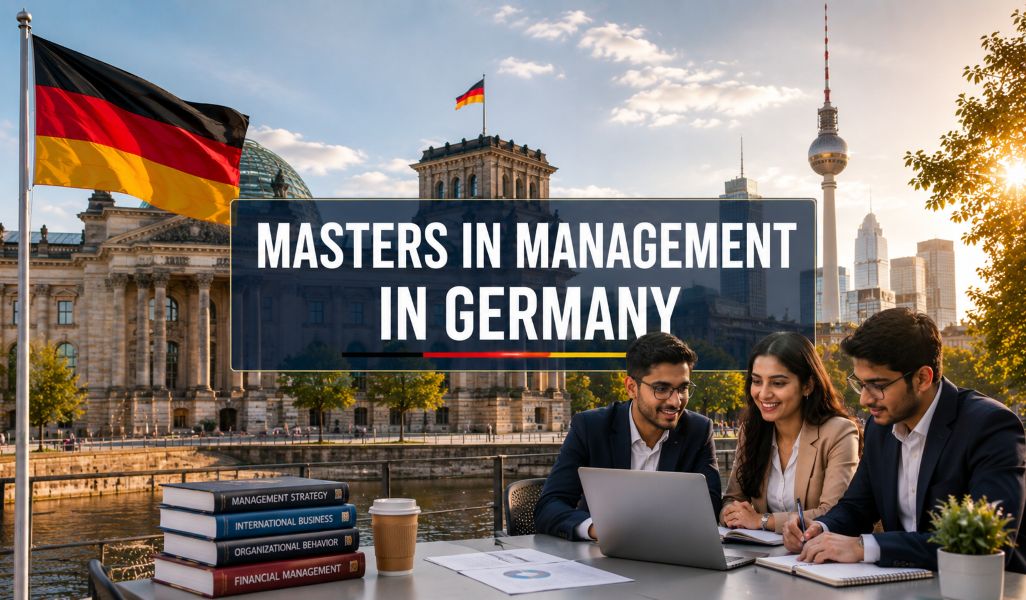
Masters in Management in Germany
Table of Contents
- What is Masters in Management (MiM)?
- Top Universities for Masters in Management in Germany
- Public vs Private Universities for Masters in Management
- Popular Specialisations in Masters in Management
- Best Cities to Study Masters in Management in Germany
- Cost of Studying Masters in Management in Germany
- Cost of Living in Germany
- Eligibility Requirements for Masters in Management
- APS Certificate for Indian Students
- Intakes & Admission Timeline
- How to Apply for a Masters in Management in Germany
- Scholarships for Masters in Management in Germany
- Career Opportunities After Masters in Management in Germany
- Is German Language Necessary?
- Internships During Masters in Management
- Post Study Work Permit & EU Blue Card
- Author’s Final Thought
Masters in Management (MiM) is specifically designed for recent graduates and young professionals looking to build management, leadership, finance, marketing, consulting and business strategy skills early in their careers
Public universities charge no tuition fees in most federal states, requiring students to pay only a semester contribution of approx. €150–€300 (₹15,000–₹30,000). Private business schools offer globally recognised MiM programs with stronger corporate exposure, international networking opportunities and dedicated career services, with tuition ranging from €15,000-€40,000 (₹15–40 lakh). Graduates benefit from 18-month post-study residence permit for employment
Key Highlights of Masters in Management in Germany
Particular | Details |
Course Duration | 1.5–2 Years |
Tuition Fees | Public: €150–€300 (Approx. ₹15,000–₹30,000), Private: €15,000–€40,000 (Approx. ₹15–40 lakh) |
Average Living Cost | €900–€1,200/month (Approx. ₹90,000–₹1.2 lakh/month) |
Popular Intakes | Winter & Summer |
Work Experience | Usually 0–2 Years |
English Requirement | IELTS 6.5+ / TOEFL Equivalent |
APS Certificate | Mandatory for Indian students |
GMAT/GRE | Required by many private business schools |
Post Study Residence Permit | Up to 18 Months |
Popular Career Fields | Consulting, Finance, Marketing, Operations, Product Management |
What is Masters in Management (MiM)?
Master in Management (MiM) is a postgraduate management degree designed for students with limited or no professional work experience. It equips graduates with practical business knowledge, analytical skills, leadership capabilities and international exposure before they enter the workforce.
The table below highlights the differences between popular management degrees:
Degree | Best Suited For | Work Experience |
Masters in Management (MiM) | Fresh graduates | 0–2 Years |
MBA | Working professionals | Usually 2–5+ Years |
MSc Management | Students seeking specialised management education | 0–2 Years |
For Indian students graduating from engineering, commerce, economics, mathematics or business backgrounds, MiM is excellent to enter international management careers without waiting several years to qualify for an MBA.
Top Universities for Masters in Management in Germany
Germany is home to Europe's highest-ranked universities and business schools offering excellent Masters in Management programs. Public universities in Germany provide affordable education, while private business schools deliver smaller class sizes, international cohorts and strong industry connections.
The table below highlights some of the best universities offering MiM in Germany:
University | Type | Approximate Tuition Fees |
University of Mannheim | Public | Semester Contribution |
Technical University of Munich (TUM) | Public | Semester Contribution |
University of Cologne | Public | Semester Contribution |
WHU – Otto Beisheim School of Management | Private | €33,000–€40,000 |
ESMT Berlin | Private | €30,000+ (Approx. ₹30 lakh+) |
Frankfurt School of Finance & Management | Private | €25,000–€39,000 (Approx. ₹25–39 lakh) |
Public vs Private Universities for Masters in Management
Masters in Germany Universities both public and private offer excellent management education,, only differ considerably in tuition fees, learning environment and career services.
The table below compares both options.
Public Universities | Private Business Schools |
Minimal semester contribution | Higher tuition fees (€15,000–€40,000) (Approx. ₹15–40 lakh) |
Larger class sizes | Smaller cohorts with personalised mentoring |
Highly research-oriented | Strong corporate partnerships and career coaching |
Limited tuition costs | Premium international exposure |
Popular Specialisations in Masters in Management
German universities offer numerous specialisations preparing graduates for global careers across multiple industries. Choosing a specialisation aligned with academic background and long-term career aspirations improves educational experience.
The table below highlights some of the most popular options.
Specialisation | Career Areas | Suitable For |
International Management | Global Business, Consulting | Commerce & Business Graduates |
Finance | Investment Banking, Financial Analysis | Commerce, Economics |
Marketing | Brand Management, Digital Marketing | Business & Arts Graduates |
Supply Chain & Operations | Manufacturing, Logistics | Engineering & Management |
Innovation & Entrepreneurship | Startups, Product Development | Engineering & Technology |
Digital Business | Business Analytics, Technology Consulting | IT & Engineering Graduates |
Best Cities to Study Masters in Management in Germany
Students planning careers in finance generally prefer Frankfurt, while those interested in startups and innovation often choose Berlin. Munich remains one of the strongest destinations for technology-driven management careers.
The table below compares Germany's leading student cities.
City | Top Universities | Best Known For |
Mannheim | University of Mannheim | Business Education & Consulting |
Munich | TUM | Technology, Engineering & Innovation |
Berlin | ESMT Berlin | Startups, Entrepreneurship & Global Companies |
Frankfurt | Frankfurt School | Banking, Finance & Consulting |
Cologne | University of Cologne | International Business & Economics |
Cost of Studying Masters in Management in Germany
Germany is Europe's most affordable destinations for management education. However, Cost of studying masters in Germany vary significantly depending on whether you choose a public university or a private business school.
The table below compares tuition costs across different university categories:
University Tier | Approx. Tuition Fees | Examples |
Public Universities | €150–€300 semester contribution | Mannheim, Cologne |
Public Technical Universities | Semester contribution or program-specific tuition | TUM |
Private Business Schools | €15,000–€40,000 (Approx. ₹15–40 lakh) | WHU, ESMT, Frankfurt School |
Cost of Living in Germany
Apart from tuition fees, students should budget carefully for accommodation, transportation, insurance, food and personal expenses.
The table below provides estimated monthly living costs.
City | Approx. Monthly Cost |
Berlin | €950–€1,200 (Approx. ₹95,000–₹1.2 lakh) |
Munich | €1,100–€1,400 (Approx. ₹1.1–1.4 lakh) |
Frankfurt | €1,000–€1,300 (Approx. ₹1–1.3 lakh) |
Cologne | €900–€1,150 (Approx. ₹85,000–₹1.05 lakh) |
Mannheim | €850–€1,050 (Approx. ₹90,000–₹1.15 lakh) |
Eligibility Requirements for Masters in Management
Admission requirements differ slightly across universities, but most institutions expect applicants to demonstrate strong academic performance and leadership potential.
The table below summarises the common eligibility criteria.
Requirement | Typical Criteria | Notes |
Bachelor's Degree | Relevant 3–4 Year Degree | Business, Economics, Engineering preferred |
Academic Score | Usually 70–75% Equivalent | Varies by university |
Work Experience | 0–2 Years | Ideal for fresh graduates |
English Proficiency | IELTS 6.5+ or TOEFL Equivalent | Mandatory for English-taught programs |
GMAT/GRE | Required by many private schools | Program Specific |
APS Certificate | Mandatory for Indian applicants | Required for visa process |
Universities also evaluate Statement of Purpose, Letters of Recommendation and resume during the admissions process.
APS Certificate for Indian Students
APS (Academic Evaluation Centre) Certificate is mandatory for almost every Indian student applying to German universities. It verifies the authenticity of your academic documents before your student visa application is processed.
The table below summarises the APS requirements for Indian applicants.
Requirement | Details | Approximate Timeline |
Issuing Authority | APS India | 3–6 Weeks |
Mandatory For | Indian Students | Yes |
Purpose | Verification of academic documents | Required before student visa |
Documents | Degree, transcripts, passport, application form | Varies by applicant |
Intakes & Admission Timeline
German universities primarily offer Winter (October) and Summer (April) intakes. However, most Masters in Management programs, especially at leading universities, admit students mainly during the Winter semester.
The table below outlines the application schedule.
Intake | Application Period | Classes Begin |
Winter Intake | May – July | October |
Summer Intake | November – January | April |
Students should ideally begin preparing their applications 8–10 months before the preferred intake. This allows sufficient time for IELTS, APS verification, document preparation, scholarship applications, and visa processing.
How to Apply for a Masters in Management in Germany
German university application process is straightforward if planned systematically. Students should begin by identifying suitable universities before completing language tests, APS verificatio, and document preparation.
The table below explains the complete application process.
Step | Action | Outcome |
1 | Shortlist universities based on eligibility, tuition, and career goals | Final university selection |
2 | Complete IELTS/TOEFL and GMAT/GRE (if applicable) | Meet admission requirements |
3 | Apply for APS Certificate | Academic verification |
4 | Submit online university applications | Admission evaluation |
5 | Receive admission letter | Confirm enrolment |
6 | Open Blocked Account and purchase health insurance | Visa preparation |
7 | Apply for German Student Visa | Visa approval |
8 | Travel to Germany and complete university registration | Begin studies |
Scholarships for Masters in Management in Germany
Although tuition at public universities is minimal, scholarships help with reducing living expenses and other financial burden. Government organisations, universities and private business schools offer merit-based funding for international students.
The table below highlights the most popular scholarship options.
Scholarship | Financial Support | Offered By |
DAAD Scholarship | €934/month (Approx. ₹93,000/month) + insurance + travel allowance | DAAD |
Deutschlandstipendium | €300/month (Approx. ₹30,000/month) | German Government |
WHU Scholarships | Partial Tuition Waiver (Up to €10,000 or Approx. ₹10 lakh) | WHU |
ESMT Scholarships | Merit Scholarships up to €15,000 (Approx. ₹15 lakh) | ESMT Berlin |
Frankfurt School Scholarships | Partial Tuition Reduction | Frankfurt School |
Career Opportunities After Masters in Management in Germany
Germany's economy is driven by manufacturing, consulting, finance, automotive, logistics, technology, and digital transformation. Consequently, MiM graduates enjoy strong employment prospects across diverse industries.
The table below highlights some of the most popular career opportunities.
Job Role | Average Annual Salary | Major Recruiters |
Management Consultant | €55,000–€80,000 (Approx. ₹55–80 lakh) | Deloitte, PwC, Accenture |
Business Analyst | €50,000–€75,000 (Approx. ₹50–75 lakh) | SAP, Amazon, Siemens |
Product Manager | €60,000–€90,000 (Approx. ₹60–90 lakh) | Bosch, BMW, Mercedes-Benz |
Financial Analyst | €55,000–€80,000 (Approx. ₹55–80 lakh) | Deutsche Bank, Allianz, EY |
Marketing Manager | €50,000–€70,000 (Approx. ₹50–70 lakh) | Adidas, Zalando, BASF |
Operations Manager | €55,000–€85,000 (Approx. ₹55–85 lakh) | Porsche, DHL, Siemens |
Most universities organise employer networking events, internships, career fairs, and company presentations, enabling students to connect directly with recruiters before graduation.
Is German Language Necessary?
Masters in Management programs are taught entirely in English, allowing international students to complete their education without advanced German proficiency. However, language skills play a major role in employability.
Students with B2–C1 German proficiency enjoy greater access to internships, graduate trainee programs, consulting firms, and client-facing management positions.
German also improves networking opportunities and helps students integrate more comfortably into everyday life.
Although not mandatory for admission, investing time in learning German often results in better long-term career outcomes.
Internships During Masters in Management
Practical exposure is an integral component of MiM in Germany. Students commonly intern with companies across consulting, finance, automotive, manufacturing, technology, logistics, and consumer goods sectors.
These internships strengthen professional networks, build practical experience, and often lead to full-time employment offers after graduation.
Post Study Work Permit & EU Blue Card
Germany offers one of Europe's strongest post-study employment pathways. After completing a recognised Mim in Germany, graduates become eligible for an 18-month residence permit to search for skilled employment.
The table below explains the progression.
Stage | Outcome | Benefit |
Complete MiM | 18-Month Residence Permit | Time to secure employment |
Obtain Skilled Job | EU Blue Card Eligibility | Long-term employment |
Continue Working | Permanent Residency Pathway | Settlement in Germany |
Graduates employed in qualifying positions can eventually transition to the EU Blue Card, followed by long-term residence and permanent settlement options.
Author’s Final Thought
Masters in Management in Germany is an excellent choice for Indian students looking to build an international management career without paying exceptionally high tuition fees. Beyond academics, Germany's thriving economy, attractive graduate salaries, and post-study employment opportunities make it one of Europe's strongest destinations for management education.
Have more questions about studying a Masters in Management in Germany? Connect on a :1 free counselling sessions with experienced study abroad experts